

Resources
Downloadable resources
Helpful tools to help manage your seizures
BRIVIACT is at your service with tools and resources, for patients and caregivers:

Adult Brochure
Download Adult Brochure
Pediatric Caregiver Brochure
Download Caregiver Brochure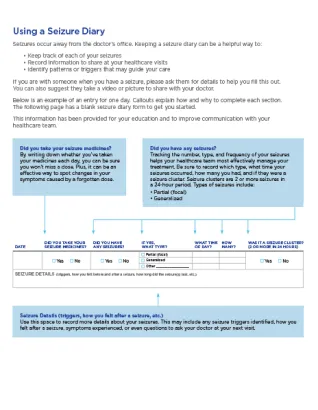
Doctor Discussion Guide
Download Doctor Discussion GuideFAQs
Frequently Asked Questions
What are partial-onset seizures?
Partial-onset seizures include:
Simple partial seizures, where a person remains fully aware (does not lose consciousness). He/she may:
- Experience muscle jerking or stiffening
- Smell, taste, see, hear, or feel things that are not there
- Experience a sudden sense of fear, depression or happiness
- Have changes in heart rate or breathing, sweating, or goose bumps
Complex partial seizures, where a person loses awareness (either partially or fully). He/she may:
- Stare blankly or may seem to be daydreaming
- Pick at the air or their clothing
- Repeat words or phrases
Why take more than one antiseizure medicine?
If you are experiencing partial-onset seizures on your current antiseizure medicine, your doctor may recommend switching your medicine or adding another antiseizure medicine to your treatment to help with seizure control. This additional medicine is called an "add-on therapy" or "adjunctive therapy."
BRIVIACT® (brivaracetam) CV is a prescription medicine that can be used to treat partial-onset seizures in people 1 month of age and older. In clinical studies, patients who added BRIVIACT to their current antiseizure treatment had fewer partial-onset seizures compared to patients who were taking a placebo and their current medicine(s).
Why take BRIVIACT?
When BRIVIACT is added to existing antiseizure medicines, it may:
- Reduce the number of partial-onset seizures in people 1 month of age and older who are currently taking one or more antiseizure medicines
- Provide additional seizure control:
- without having to give up the benefits of your current antiseizure medicine(s)
- even if you have tried or are taking multiple antiseizure medicines
In clinical trials:
- BRIVIACT was added to 1 to 2 common antiseizure medicines
- Some patients were also being treated with vagal nerve stimulation (VNS)
- The most common side effects of BRIVIACT included sleepiness, dizziness, feeling tired, and nausea and vomiting. Most of these side effects were reported to be mild to moderate
Starting Day One with BRIVIACT:
- Your doctor will tell you how much BRIVIACT to take and when to take it. You start with the full recommended dose from day one. BRIVIACT does not require titration – which means that you may not need to increase your dose over several weeks. See Taking BRIVIACT for complete information on taking BRIVIACT
BRIVIACT may not be for everyone. You and your doctor should discuss the possible benefit and risks of treatment with BRIVIACT.
How does BRIVIACT work?
The exact way that BRIVIACT works is not yet fully understood, but it is thought that BRIVIACT reduces the frequency of partial-onset seizures by binding to synaptic vesicle protein 2A (SV2A) in the brain.
What are the most common side effects of BRIVIACT?
The most common side effects of BRIVIACT in adults include:
- sleepiness
- dizziness
- feeling tired
- nausea and vomiting
Side effects of BRIVIACT in children 1 month to less than 16 years of age are similar to those seen in adults.
These are not all the possible side effects of BRIVIACT. For more information, ask your healthcare provider or pharmacist. Tell your healthcare provider about any side effect that bothers you or that does not go away. Call your doctor for medical advice about side effects.
Please see additional patient information in the Medication Guide. This information does not take the place of talking with your healthcare provider about your condition or your treatment.
Helpful Links